


This article provides you with:
An understanding of the distinction between “programs” and “experiences” in the arts sector.
Insight into why many institutions claim to be moving toward experience-driven engagement.
Practical examples from museums, galleries, and arts education.
Critical questions for arts professionals to reflect on in their own work.
Perspectives on potential pitfalls and limitations of the “experience-first” approach.
Special Announcement:

ArtForms x Art Institutes
We are pleased to announce an official collaboration with ArtForms.net, the premier form-builder designed specifically for the creative industry. Whether you are managing gallery inquiries, workshop registrations, or student applications, ArtForms provides the professional tools you need for your workflow.
Claim Your Special Lifetime Offer!!!
To celebrate this partnership, we are offering a Special Lifetime Offer—but act fast, as this is limited to the first 250 next 157 accounts created.
How to claim your offer:
Step 1: You must first create a free account at ArtForms.net.
Step 2: Once your account is active, visit artforms.net/special-offer to claim your lifetime deal.
(Note: You must be logged into your new ArtForms account for the claim page to function.)
Defining Programs vs. Experiences
The first step in evaluating whether a shift is occurring is to clarify what we mean by “programs” and “experiences.”
Programs are structured activities with clear objectives and predefined outcomes. They include workshops, lectures, art classes, residencies, exhibitions, and outreach initiatives. Programs are often assessed based on participation metrics, learning outcomes, or attendance numbers.
Experiences, on the other hand, prioritize the holistic engagement of the audience. Experiences are immersive, often personalized, and aim to evoke emotional, intellectual, or social responses beyond the functional purpose of the activity. They may blur boundaries between observer and participant, often relying on storytelling, interactivity, or multi-sensory engagement.
The key distinction lies in intentionality and perception: programs focus on delivering content or service, whereas experiences focus on shaping the audience’s journey and memory.
The Drivers Behind the Shift
Several factors contribute to the arts sector’s increasing emphasis on experiences:
Audience Expectations: In a world saturated with digital content and interactive entertainment, audiences increasingly value engagement that feels personal, participatory, or memorable. People don’t just want to attend a lecture—they want to “live” it.
Competition and Relevance: Museums, galleries, and arts organizations compete not only with each other but with other forms of leisure and cultural consumption. Experiences offer a way to differentiate institutions and create lasting impressions.
Funding and Metrics: Funders and sponsors increasingly expect evidence of impact that extends beyond attendance numbers. Story-driven experiences can produce compelling qualitative narratives that demonstrate cultural and social value.
Technological Possibilities: Digital and immersive technologies—virtual reality, augmented reality, interactive apps—allow institutions to design experiences that were previously impossible in traditional program formats.
Examples in Practice
Museums and Galleries
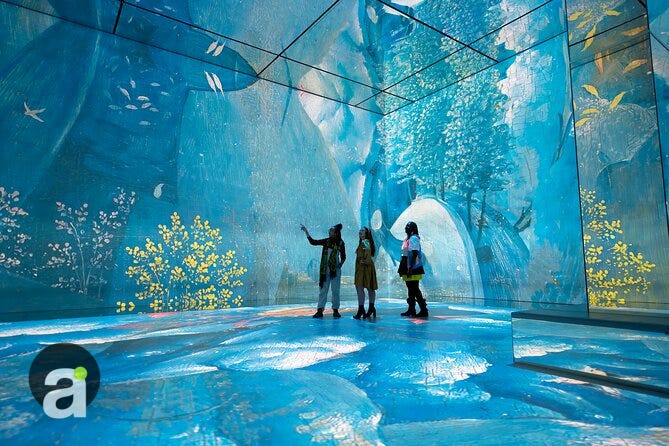
Some institutions have embraced experiences in dramatic ways. For example, immersive exhibitions such as those that replicate Van Gogh’s studio or allow visitors to interact with digital art installations transform a passive viewing into a multi-sensory journey. Yet, it’s important to ask: are these experiences integrated into the institution’s long-term educational goals, or are they one-off spectacles designed for social media engagement?
Arts Education
In the classroom or workshop, experience-driven learning can take many forms. Instead of a standard painting class (program), some educators invite students to co-create a public art installation (experience), incorporating collaboration, decision-making, and audience interaction. Here, the shift is not merely about novelty but about deepening engagement and understanding.
Community Arts and Outreach
Community programs often emphasize participation and co-creation over presentation. For instance, storytelling workshops that culminate in a neighborhood performance or art walk are not just programs—they are curated experiences that integrate process, context, and community engagement.
Critical Questions for Arts Professionals
While the rhetoric of “experience over program” is pervasive, it’s crucial for arts professionals to critically assess whether this shift is real or rhetorical. Consider these questions:
Are experiences genuinely transforming engagement, or are they just repackaged programs with a “cool” label?
How do you measure the success of experiences compared to traditional programs?
Are experiences inclusive, accessible, and sustainable, or do they cater to niche audiences and high-ticket events?
Does the shift toward experiences risk overshadowing fundamental educational or curatorial objectives?
Challenges and Limitations
Despite the appeal of experiences, there are practical and philosophical challenges:
Resource Intensity: Experiences often require more time, personnel, and technology. Smaller institutions may struggle to implement them effectively.
Evaluation Difficulties: Unlike programs with clear learning objectives or attendance targets, experiences are harder to quantify. Funders and boards may struggle to see their impact.
Sustainability: Many “experience-driven” initiatives rely on novelty. There’s a risk of chasing the next immersive trend rather than fostering meaningful, ongoing engagement.
Equity Considerations: Experiences may inadvertently privilege audiences with more disposable income, digital access, or familiarity with contemporary arts culture. Programs can sometimes ensure broader inclusivity through structured and accessible design.
Seeing the Shift in Context
So, is there really a shift? The answer is nuanced. There is a trend toward experience-oriented engagement, but it coexists with traditional programmatic approaches. In some cases, experiences are an evolution of programs rather than a replacement. Institutions are experimenting, blending structured learning with immersive participation, but it is not yet a universal, sector-wide transformation.
Arts professionals should think critically about why they design experiences and for whom, rather than assuming that “experience-first” is inherently superior. The most successful institutions are those that integrate programs and experiences in complementary ways using experiences to enhance, not replace, programs.
Final Thoughts
The shift from programs to experiences is real in certain contexts, particularly in audience-facing, immersive, or technology-enhanced initiatives. Yet, it is not absolute. Programs remain essential for learning, accessibility, and sustaining institutional missions. By reflecting on both their successes and limitations, arts professionals can design initiatives that balance structured engagement with meaningful, memorable experiences.
The key takeaway: the future of the arts sector may not be a binary choice between programs and experiences. It may be about creating a spectrum of engagement that responds to audience needs, institutional goals, and societal change.
A Quick Survey (Expert Opinion)
As part of improving our understanding of current trends in the arts sector, we’re gathering insights from professionals across the field.
We’ve created a short, focused survey (2–3 minutes) to understand:
How your institution or organization balances programs and experiences
What challenges you face in creating engaging experiences
Which strategies or tools have been most effective in enhancing audience engagement
Your input will help shape future resources, benchmarks, and insights for arts educators, managers, and professionals.
(Click below for the Expert Survey)
👉 [Participate in the Expert Survey]
Powered by ArtForms

Discover the World’s Top Art Institutes at https://artinstitutes.org